Greetings from the music room! It was a another exciting week of singing, moving, and playing instruments! Here are some of the
highlights:
Kindergarten students learned a new chant entitled Little Bird.
Students learned the words to this chant and were asked to pat and hop
on the 'special' words. Later students will transfer these special words
onto the xylophone and play it using two hands! Up until this point,
students have been working with only one mallet. The main focus has been
on student familiarity with the instrument rather than technique.
Students also reviewed the song Two Little Black Birds. Each
student enjoyed having the chance to be either the bird named Jack or the bird named Jill. Students added flying sounds by playing glissandos on the xylophone. Lastly,
students completed a steady beat assessment by marching around the
classroom to the steady beat of a drum. It is rather impressive how much
progress Kindergarten students have made on steady beat this year!
First grade students reviewed the melodic notes and game for the song Lucy Locket. Students then worked with partners to practice transferring their knowledge of melodic notes sol mi and la to the xylophone. After having time to practice, students were invited to play the song for the class. It was quite thrilling to watch how successful the students were at transferring their prior knowledge to this instrument!
Second grade students practiced melodic notes do re mi sol and la this week using a song entitled Do As I'm Doing. After copying several motions performed by the teacher, students were asked to come up with their own movements. Each student in turn was given a turn to lead the class in movement. Students also practiced playing melodic notes do mi sol and la on the xylophone. Students were given a packet containing six new melodic flashcards. Students were instructed to work with partners and to play these patterns on the xylophone. After students were successful in playing these patterns, there were asked to arrange their favorite cards to create a song. Some students used all six cards! Students also reviewed the chant Jeremiah and continued to review musical terms piano (quiet) and forte (loud).
Third grade students continued to explore musical form this week through the song I've Been to Harlem. Students were introduced to the two main sections of the song as well as two additional sections of movement. Each section was labeled with a letter: A, B, C, or D. For each section, the students were to either sing and move or simply move. After students fully understood what to do for each section, the class explored different combinations of letters. For example: ABA, ABCBA, ABACDABC, etc. Students particularly enjoyed being asked to reshuffle the letters to create a new form. It very enjoyable to watch the students respond as quickly as possible when one section changed to the next. Lastly, students learned a new song containing low sol and low la (Big Eyed Rabbit).
Fourth grade students continued to study sixteenth notes this week. Students reviewed the song and Orff arrangement (xylophones) to the song Chatter with the Angels. Students then learned a new song entitled I Lost the Farmer's Dairy Key. This song has a fun rock/paper/scissors game and an Orff arrangement that contains sixteenth notes. Students learned the game as well as a series of three body percussion patterns that will later be transferred to xylophones. Additionally, students reviewed the song and game Rabbit and the Possum as well as the rhythm game Heads Up, Rhythms Up.
Fifth grade students took a one day mini-break from our music evaluation unit this week. In order to give students a bit of a mental break before diving into our final project, students enjoyed a change of pace in the form of a rhythm stick movement activity. Students learned a two-part (AB) pattern for the Swedish song Fjaskern. The pattern included tapping the rhythm sticks on hands, hips, and shoes as well as passing the sticks around the circle. It was quite the challenge for students to stay with the steady beat and not drop their sticks. After becoming acquainted with this pattern, students performed it to recorded music. The best part about the recording was that it gradually got faster and faster! As the recording sped up students really had to concentrate in order to keep the pattern going! Following this mental break, students began working on their final project: creating a listening map that contains at least three elements (instruments, form, rhythm, pitch, and/or dynamics) to Chopin's Waltz No. 1.
Thursday, June 16, 2016

Tuesday, May 24, 2016
Week Thirty Four in Review (May 16 - May 20)
Greetings from the music room! It was a another exciting week of singing, moving, and playing instruments! Here are some of the
highlights:
Kindergarten students reviewed the dramatic play You Must Pay the Rent. After reviewing the dramatic play, students worked in groups of three to prepare a short 'performance' of the play. After having the opportunity to practice together and divide the parts, students were invited to the front of the classroom and to perform for the rest of the class. Students also began learning a new song entitled Two Little Black Birds. Students took turns being Jack and Jill and flying around the classroom. Next week, students will also play xylophones during this song in order to create the sound of flying birds.
First grade students reviewed the rhythm to Haydn's Surprise Symphony. First, students read the rhythm and performed tiptoe movements while listening to the recording. Then students were into four groups, each with a different instrument. Students were challenged to play their instrument only on notes containing their group's color. This was a fun challenge for the students and they enjoyed playing the instruments! Students also played xylophones this week and began transferring melodic notes sol mi and la onto the xylophone. Students reviewed the song Lucy Locket and the written music for this song. Students then worked with a partner to transfer their knowledge to the xylophone and play the song.
A big thank you to all of the students and families who came to our music informance nights this week! It was such a pleasure to share your first grader's newfound knowledge of music with you. Thank you again for coming!
Second grade students focused heavily on melodic notes do re mi sol and la this week. Students reviewed the song All Around the Buttercup and practiced singing the song using solfege. After students were secure in their ability to sing the song using melodic notes do re mi sol and la, students began learning how to transfer these notes to the xylophone. Students worked with partners while learning to play the song. After having the opportunity to work with one another and practice, students were invited to play the song for the class. Not only did students do a terrific job performing the song, they were a wonderful audience for their classmates! Lastly, students began learning a chant entitled Jeremiah which will be used to review the Italian terms for loud and quiet (forte and piano).
Third grade students began learning about form this week by analyzing a well-known song, Chatter with the Angels. Students discovered that the form to this song is ABAC. In other words, the first and third lines are the same while the second and fourth lines are different. Letters that repeat represent music that repeats. Likewise, letters that are different represent music that is different. Next, students learned a Swedish dance called Fjaskern which is performed in a repeating AB form. This dance allowed students to physically experience form through movement. Students were especially surprised by the end of this dance; the recording gradually gets faster and faster!
Fourth grade students began focusing on sixteenth notes this week. Students reviewed the spiritual Chatter with the Angels and discovered the location of sixteenth notes within this song. Students then learned an Orff arrangement to accompany this song. Students played glockenspiels, soprano xylophones, alto xylophones, and bass xylophones. Students also learned a game called Heads Up, Rhythms Up, a musical variation on the game Heads Up, Seven Up. Additionally, students learned a fun hide and seek game to the song Rabbit and the Possum. The song Rabbit and the Possum will be used to reinforce sixteenth notes.
Fifth grade students created a pitch and rhythm listening map for Ballet of the Unhatched Chicks this week. While listening to the beginning of the piece many times, students charted the ups and downs of the melody as well as the location of the song's long and short sounds. Students used lines and dots to represent the pitches and rhythms of the song. Students were also encouraged to incorporate the theme of the song into their listening maps. Many students drew clever pictures of dancing eggs or chicks in tutus.
Kindergarten students reviewed the dramatic play You Must Pay the Rent. After reviewing the dramatic play, students worked in groups of three to prepare a short 'performance' of the play. After having the opportunity to practice together and divide the parts, students were invited to the front of the classroom and to perform for the rest of the class. Students also began learning a new song entitled Two Little Black Birds. Students took turns being Jack and Jill and flying around the classroom. Next week, students will also play xylophones during this song in order to create the sound of flying birds.
First grade students reviewed the rhythm to Haydn's Surprise Symphony. First, students read the rhythm and performed tiptoe movements while listening to the recording. Then students were into four groups, each with a different instrument. Students were challenged to play their instrument only on notes containing their group's color. This was a fun challenge for the students and they enjoyed playing the instruments! Students also played xylophones this week and began transferring melodic notes sol mi and la onto the xylophone. Students reviewed the song Lucy Locket and the written music for this song. Students then worked with a partner to transfer their knowledge to the xylophone and play the song.
 |
| These students are practicing the song Lucy Locket on the xylophone. |
Second grade students focused heavily on melodic notes do re mi sol and la this week. Students reviewed the song All Around the Buttercup and practiced singing the song using solfege. After students were secure in their ability to sing the song using melodic notes do re mi sol and la, students began learning how to transfer these notes to the xylophone. Students worked with partners while learning to play the song. After having the opportunity to work with one another and practice, students were invited to play the song for the class. Not only did students do a terrific job performing the song, they were a wonderful audience for their classmates! Lastly, students began learning a chant entitled Jeremiah which will be used to review the Italian terms for loud and quiet (forte and piano).
 |
| Students in Mrs. Locey's class are hard at work with their partners. They are learning to play All Around the Buttercup. |
Third grade students began learning about form this week by analyzing a well-known song, Chatter with the Angels. Students discovered that the form to this song is ABAC. In other words, the first and third lines are the same while the second and fourth lines are different. Letters that repeat represent music that repeats. Likewise, letters that are different represent music that is different. Next, students learned a Swedish dance called Fjaskern which is performed in a repeating AB form. This dance allowed students to physically experience form through movement. Students were especially surprised by the end of this dance; the recording gradually gets faster and faster!
Fourth grade students began focusing on sixteenth notes this week. Students reviewed the spiritual Chatter with the Angels and discovered the location of sixteenth notes within this song. Students then learned an Orff arrangement to accompany this song. Students played glockenspiels, soprano xylophones, alto xylophones, and bass xylophones. Students also learned a game called Heads Up, Rhythms Up, a musical variation on the game Heads Up, Seven Up. Additionally, students learned a fun hide and seek game to the song Rabbit and the Possum. The song Rabbit and the Possum will be used to reinforce sixteenth notes.
Fifth grade students created a pitch and rhythm listening map for Ballet of the Unhatched Chicks this week. While listening to the beginning of the piece many times, students charted the ups and downs of the melody as well as the location of the song's long and short sounds. Students used lines and dots to represent the pitches and rhythms of the song. Students were also encouraged to incorporate the theme of the song into their listening maps. Many students drew clever pictures of dancing eggs or chicks in tutus.
Week Thirty Three in Review (May 9 - May 13)
Greetings from the music room! It was a another exciting week of singing, moving, and playing instruments! Here are some of the
highlights:
Kindergarten students learned a new song for steady beat this week: Bling, Blang. In this song students pretended to use their hands, feet, and heads as hammers and saws. Students were asked to make hammering and sawing motions to the steady beat while singing the song. Students especially enjoyed the challenge of hammering with one hand while sawing with the other. It was actually quite impressive how many students were able to do this successfully! Students combined marching and playing ups and downs on the xylophone during the chant The King of France. As part of this activity, students were divided into four kingdoms. One student was chosen as the king or queen of each kingdom and another student was selected as the kingdom's musician. The king or queen's job was to lead the rest of the students around the room by marching to the steady beat. The musician's job was to play the ups and downs of the lyrics on the xylophone. Lastly, students began learning a song for solo singing entitled Who Has the Nickel.
First grade students reviewed the song All Around the Buttercup and the dramatic play You Must Pay the Rent. After reviewing the dramatic play, students worked in groups of three to prepare a short 'performance' of the play. After having the opportunity to practice together and divide the parts, students came to the front of the classroom and performed for the class. Students also continued to practice sol and mi through the song Merlin, Merlin. This week students learned a game that added a solo singing section to the song. After singing the song, four students improvised on xylophones to create the sound of magic music as the rest of the class passed around a bean bag (magic potion). At the sound of finger cymbals, everyone froze. Mrs. Aaronson then asked the student holding the bean bag "What did you wish for?" and the student sang his or her response.
Second grade students began learning a song entitled All Around the Buttercup. This song contains a new melodic note: re. Students enjoyed singing this song while playing its game. In the game, students gradually added themselves to a train that snaked in and out of the circle. After becoming familiar with the song, students were introduced to the new note, re, and discovered the placement of this note (in between do and mi). In order to practice all previously known notes, students were asked to place melodic cards for the song Mouse, Mousie in the correct order. Students worked with partners in order to decode each card, sing its pattern, and place them in the correct order. Students also completed their rhythm post-assessment this week. Students have made remarkable progress in their ability to read second grade level rhythms since the beginning of the school year!
Third grade students took their rhythm post-assessment this week and achieved 100% growth or mastery! Wonderful job third graders! Prior to taking the assessment, students reviewed all third grade rhythms by playing another round of the game Rhythm Go Fish. Students also learned an African American Spiritual entitled Get on Board and enjoyed playing sandblocks along with this song.
Fourth grade students continued to review rhythm this week by adding dotted half notes into rhythmic patterns. After reviewing how to count and clap dotted half notes, students worked in groups of four to play a game called Rhythm Go Fish. The rules to this game are identical to Go Fish; however, students must ask for a card by clapping the rhythm they wish to receive. Students also reviewed rhythm and form by playing rhythm sticks along with the composition 12th Street Rag. Lastly, students learned an African American Spiritual entitled Get on Board and enjoyed playing sandblocks along with this song.
Fifth grade students studied three pitch and rhythm listening maps this week. As pitch can be the most difficult musical element for students to write, much time has been devoted to it. The first map was for the composition Island Rhythms. This complex map was a challenge for many students to follow and highlighted the importance of creating a clear and easy to follow listening map. Next, students studied maps for March from The Nutcracker and Norwegian Dance. Both of these maps demonstrated how pitch maps can also show the long and short sounds in the piece (rhythm). Students were challenged to follow along with these maps while listening to a recording. Students also reviewed terms for form such as D.C. al Fine and Coda.
Kindergarten students learned a new song for steady beat this week: Bling, Blang. In this song students pretended to use their hands, feet, and heads as hammers and saws. Students were asked to make hammering and sawing motions to the steady beat while singing the song. Students especially enjoyed the challenge of hammering with one hand while sawing with the other. It was actually quite impressive how many students were able to do this successfully! Students combined marching and playing ups and downs on the xylophone during the chant The King of France. As part of this activity, students were divided into four kingdoms. One student was chosen as the king or queen of each kingdom and another student was selected as the kingdom's musician. The king or queen's job was to lead the rest of the students around the room by marching to the steady beat. The musician's job was to play the ups and downs of the lyrics on the xylophone. Lastly, students began learning a song for solo singing entitled Who Has the Nickel.
First grade students reviewed the song All Around the Buttercup and the dramatic play You Must Pay the Rent. After reviewing the dramatic play, students worked in groups of three to prepare a short 'performance' of the play. After having the opportunity to practice together and divide the parts, students came to the front of the classroom and performed for the class. Students also continued to practice sol and mi through the song Merlin, Merlin. This week students learned a game that added a solo singing section to the song. After singing the song, four students improvised on xylophones to create the sound of magic music as the rest of the class passed around a bean bag (magic potion). At the sound of finger cymbals, everyone froze. Mrs. Aaronson then asked the student holding the bean bag "What did you wish for?" and the student sang his or her response.
Second grade students began learning a song entitled All Around the Buttercup. This song contains a new melodic note: re. Students enjoyed singing this song while playing its game. In the game, students gradually added themselves to a train that snaked in and out of the circle. After becoming familiar with the song, students were introduced to the new note, re, and discovered the placement of this note (in between do and mi). In order to practice all previously known notes, students were asked to place melodic cards for the song Mouse, Mousie in the correct order. Students worked with partners in order to decode each card, sing its pattern, and place them in the correct order. Students also completed their rhythm post-assessment this week. Students have made remarkable progress in their ability to read second grade level rhythms since the beginning of the school year!
 |
| Two students correctly placed all of the Mouse, Mousie cards in the correct order. The mice in the roof represent sol, the mice on the second level represent mi, and the mice on the first floor represent do. |
 |
| These students are checking their work by pointing to each mouse while singing the song. |
Third grade students took their rhythm post-assessment this week and achieved 100% growth or mastery! Wonderful job third graders! Prior to taking the assessment, students reviewed all third grade rhythms by playing another round of the game Rhythm Go Fish. Students also learned an African American Spiritual entitled Get on Board and enjoyed playing sandblocks along with this song.
Fourth grade students continued to review rhythm this week by adding dotted half notes into rhythmic patterns. After reviewing how to count and clap dotted half notes, students worked in groups of four to play a game called Rhythm Go Fish. The rules to this game are identical to Go Fish; however, students must ask for a card by clapping the rhythm they wish to receive. Students also reviewed rhythm and form by playing rhythm sticks along with the composition 12th Street Rag. Lastly, students learned an African American Spiritual entitled Get on Board and enjoyed playing sandblocks along with this song.
Fifth grade students studied three pitch and rhythm listening maps this week. As pitch can be the most difficult musical element for students to write, much time has been devoted to it. The first map was for the composition Island Rhythms. This complex map was a challenge for many students to follow and highlighted the importance of creating a clear and easy to follow listening map. Next, students studied maps for March from The Nutcracker and Norwegian Dance. Both of these maps demonstrated how pitch maps can also show the long and short sounds in the piece (rhythm). Students were challenged to follow along with these maps while listening to a recording. Students also reviewed terms for form such as D.C. al Fine and Coda.
Monday, May 9, 2016
First Grade Informances Reminder
Dear First Grade Families:
I hope that you are enjoying the beautiful spring weather that we have
been having the last few days! I am writing to remind you that the first grade
music informances are next week! What is an informance? I am so glad you asked!
It is a family participatory event in which families are invited to sing songs,
dance, and play musical games alongside of their first grade students. Please
come dressed in comfortable clothes and shoes! This will be an opportunity for
first graders to shine and truly show-off all of the musical skills that they
have developed this year. As first grade is a time in which students develop
basic music reading skills, you will be able to see your child read and perform
simple rhythms and melodies. I am so proud of the progress that our students
have made in music this year and I cannot wait to show you a year’s worth of progress!
Each informance will be held in the LLE gym. Below are the dates and times for each class:
Tues. May 17th at 6:30-7:15 p.m. - Mrs. Bandy's class
Wed. May 18th at 6:30-7:15 p.m. - Mrs. Doran's class
Thurs. May 19th at 6:30-7:15 p.m. - Mrs. Tisdall's class
Wed. May 18th at 6:30-7:15 p.m. - Mrs. Doran's class
Thurs. May 19th at 6:30-7:15 p.m. - Mrs. Tisdall's class
I look forward to seeing you soon! Please feel free to email me if
you have any questions.
Sincerely,
Mrs. Aaronson
NicoleAaronson@wlcsd.org
Week Thirty Two in Review (May 2 - May 6)
Greetings from the music room! It was a another exciting week of singing, moving, and playing instruments! Here are some of the
highlights:
Kindergarten students continued to differentiate between high and low sounds this week. Students practiced the dramatic play You Must Pay the Rent and learned a new chant called The King of France. During The King of France, students were asked to march to the steady beat of a drum like soldiers. It was very exciting to watch students march around the room to the beat; several months ago many students were nowhere near able to march to the beat! After marching, students were asked to add xylophones to the chant. Anytime the king referred to soldiers going up the hill, students played an ascending glissando on the xylophone. When the king referred to soldiers going down the hill, students played a descending glissando. Students also explored the upward and downward motion of their voices through a vocal exploration activity called Toss Across. In this activity, students tossed a bean bag to a friend while making their voices follow the shape of the bean bag. Students particularly enjoyed being able to spread out all around the classroom!
First grade students reviewed melodic notes sol mi and la this week. Students were asked to identify these notes as a class by changing notes to the correct color on the interactive white board. Students also practiced sight reading/singing sol and mi patterns. In fact, students began teaching themselves the song Merlin! Rather than echoing patterns after Mrs. Aaronson, students were given a starting pitch and asked to decode the melody on their own. After a student correctly sang the melody, the class was asked to echo that student. Once the piece was completely decoded, the students worked to put the piece together and sing the entire song. Students also began learning a song entitled All Around the Buttercup which contains melodic notes sol mi and la. Students enjoyed singing this song while playing its game. In the game, students gradually added themselves to a train that snaked in and out of the circle. Lastly, students learned a fun dramatic play called You Must Pay the Rent and practiced speaking in high and low voices.
Second grade students were formally introduced to whole notes this week. Students were led to understand that combing two halves (two half notes) equals a whole (whole note) and that a whole note receives four beats. Students then practiced reading and identifying a series of rhythmic patterns in preparation for the second grade rhythm assessment. Students also continued to review melodic note 'do' through the song Mouse, Mousie. Additionally, students explored many different answers to the phrase "Daddy fishing in a brook, caught a _______ on a hook." Students took turns speaking the sentence rhythmically and inserting their own noun in the blank. Examples of answers include catfish, tire, pizza, and boot.
Third grade students were led in a discussion about last week's field trip to the Detroit Symphony Orchestra. As part of this discussion, students shared their favorite part of the concert and expanded upon some of the ideas and activities they experienced. One class held a conversation about different types of instruments. Another class experimented with recreating the sounds of a thunder storm. And yet another class decided to simultaneously sing two non-complimentary songs (London Bridge and Chicken on a Fence Post) in order to imitate a composition from the field trip written by the American composer Charles Ives. Students also began learning a new song containing dotted half notes entitled Wake Up Canon. Students were challenged to find the location of the song's dotted half notes. Students also wrote and sang the solfege for the song Chicken on a Fence Post. Students enjoyed trying to sing the solfege of this song from memory. Lastly, students enjoyed playing another round of Rhythm Go Fish. This rhythm game was designed to prepare students for the third grade rhythm post-assessment next week.
Fourth grade students began a rhythm unit this week. Students reviewed quarter notes/rests, half notes/rests, whole notes, and eighth notes. Students played a rhythm review game while singing the song Black Snake. During this game, whichever student had the black snake at the end of the song got to choose a rhythm and attempt to earn points for his or her team. Rhythms were worth either one or two points depending on the difficulty of the rhythm. Students also learned a new song, Chatter with the Angels. This song will be used to help students become more adept at identifying sixteenth notes. Students finished the week with a recorder day. Students learned the first section of an 80's rock style song called Slow and Steady Wins the Race. In this song students reviewed recorder notes E, G, and A. After learning the first section of the song together as a class, students were challenged to sight read the second section of the song. Lastly, students were given the opportunity go complete the next test in recorder karate.
Fifth grade students were introduced to complex form this week. A piece with complex form has small sections of form within bigger sections. For example, a piece may have an overall form of ABA; however, with in the A section there may be another aba pattern. Students studied a piece entitled March Past of the Kitchen Utensils and added dynamics to its listening map. Students noticed that the dynamics were tied to the melody; the dynamics stayed the same each time the same melody was presented. Students discovered that assigning dynamics is a somewhat subjective task. For example, after listening to a piece one student might have chosen piano (quiet) as a dynamic marking while another student might have chosen mezzo piano (medium quiet). After completing this assignment, students were introduced to a listening map for Camille Saint-Saens' composition Aquarium. This brilliant listening map was used to introduce students to a new evaluation component: pitch. After listening to the piece of music and studying the listening map, students were able to make observations about it that Mrs. Aaronson had completely overlooked. Wonderful job, fifth grade!
Kindergarten students continued to differentiate between high and low sounds this week. Students practiced the dramatic play You Must Pay the Rent and learned a new chant called The King of France. During The King of France, students were asked to march to the steady beat of a drum like soldiers. It was very exciting to watch students march around the room to the beat; several months ago many students were nowhere near able to march to the beat! After marching, students were asked to add xylophones to the chant. Anytime the king referred to soldiers going up the hill, students played an ascending glissando on the xylophone. When the king referred to soldiers going down the hill, students played a descending glissando. Students also explored the upward and downward motion of their voices through a vocal exploration activity called Toss Across. In this activity, students tossed a bean bag to a friend while making their voices follow the shape of the bean bag. Students particularly enjoyed being able to spread out all around the classroom!
First grade students reviewed melodic notes sol mi and la this week. Students were asked to identify these notes as a class by changing notes to the correct color on the interactive white board. Students also practiced sight reading/singing sol and mi patterns. In fact, students began teaching themselves the song Merlin! Rather than echoing patterns after Mrs. Aaronson, students were given a starting pitch and asked to decode the melody on their own. After a student correctly sang the melody, the class was asked to echo that student. Once the piece was completely decoded, the students worked to put the piece together and sing the entire song. Students also began learning a song entitled All Around the Buttercup which contains melodic notes sol mi and la. Students enjoyed singing this song while playing its game. In the game, students gradually added themselves to a train that snaked in and out of the circle. Lastly, students learned a fun dramatic play called You Must Pay the Rent and practiced speaking in high and low voices.
 |
| Mrs. Doran's class playing All Around the Buttercup. The train is not very long yet. |
 |
| The train is getting bigger! |
 |
| These three ladies are using a 'mustache' a 'hair bow' and a 'bow tie' to play their characters in You Must Pay the Rent. |
Second grade students were formally introduced to whole notes this week. Students were led to understand that combing two halves (two half notes) equals a whole (whole note) and that a whole note receives four beats. Students then practiced reading and identifying a series of rhythmic patterns in preparation for the second grade rhythm assessment. Students also continued to review melodic note 'do' through the song Mouse, Mousie. Additionally, students explored many different answers to the phrase "Daddy fishing in a brook, caught a _______ on a hook." Students took turns speaking the sentence rhythmically and inserting their own noun in the blank. Examples of answers include catfish, tire, pizza, and boot.
Third grade students were led in a discussion about last week's field trip to the Detroit Symphony Orchestra. As part of this discussion, students shared their favorite part of the concert and expanded upon some of the ideas and activities they experienced. One class held a conversation about different types of instruments. Another class experimented with recreating the sounds of a thunder storm. And yet another class decided to simultaneously sing two non-complimentary songs (London Bridge and Chicken on a Fence Post) in order to imitate a composition from the field trip written by the American composer Charles Ives. Students also began learning a new song containing dotted half notes entitled Wake Up Canon. Students were challenged to find the location of the song's dotted half notes. Students also wrote and sang the solfege for the song Chicken on a Fence Post. Students enjoyed trying to sing the solfege of this song from memory. Lastly, students enjoyed playing another round of Rhythm Go Fish. This rhythm game was designed to prepare students for the third grade rhythm post-assessment next week.
Fourth grade students began a rhythm unit this week. Students reviewed quarter notes/rests, half notes/rests, whole notes, and eighth notes. Students played a rhythm review game while singing the song Black Snake. During this game, whichever student had the black snake at the end of the song got to choose a rhythm and attempt to earn points for his or her team. Rhythms were worth either one or two points depending on the difficulty of the rhythm. Students also learned a new song, Chatter with the Angels. This song will be used to help students become more adept at identifying sixteenth notes. Students finished the week with a recorder day. Students learned the first section of an 80's rock style song called Slow and Steady Wins the Race. In this song students reviewed recorder notes E, G, and A. After learning the first section of the song together as a class, students were challenged to sight read the second section of the song. Lastly, students were given the opportunity go complete the next test in recorder karate.
Fifth grade students were introduced to complex form this week. A piece with complex form has small sections of form within bigger sections. For example, a piece may have an overall form of ABA; however, with in the A section there may be another aba pattern. Students studied a piece entitled March Past of the Kitchen Utensils and added dynamics to its listening map. Students noticed that the dynamics were tied to the melody; the dynamics stayed the same each time the same melody was presented. Students discovered that assigning dynamics is a somewhat subjective task. For example, after listening to a piece one student might have chosen piano (quiet) as a dynamic marking while another student might have chosen mezzo piano (medium quiet). After completing this assignment, students were introduced to a listening map for Camille Saint-Saens' composition Aquarium. This brilliant listening map was used to introduce students to a new evaluation component: pitch. After listening to the piece of music and studying the listening map, students were able to make observations about it that Mrs. Aaronson had completely overlooked. Wonderful job, fifth grade!
Sunday, May 1, 2016
Week Thirty One in Review (Apr. 25 - Apr. 29)
Greetings from the music room! It was a another exciting week of singing, moving, and playing instruments! Here are some of the
highlights:
Kindergarten students learned a new fingerplay entitled Ten Little Soldiers this week. After learning the words and the actions, students were challenged to speak the chant in their head while performing the actions. Students enjoyed the challenge and later performed the chant in the order of speak-think-speak. The process of audiating (hearing something in your head) is an important skill for young musicians to develop as it will later help them to successfully sight read music. Students also reviewed the differences between high and low sounds and were challenged to find the high and low sides of a xylophone. Students were individually assessed on this skill and have made a remarkable amount of progress since the beginning of the year! Students also learned a fun dramatic play called You Must Pay the Rent and practiced speaking in high and low voices.
First grade students reviewed quarter notes and eighth notes by learning the rhythm to Haydn's Surprise Symphony. Students read the rhythm from the white board and reviewed the meaning of a repeat sign. After students were successful at performing the rhythm, students were asked to follow along on the board while listening to the recording. Students were asked to determine "what was the surprise?" The surprise, of course, was the very loud note at the end of the first section of music! Next, students were asked to tiptoe around the room on eighth notes, look behind them mischievously on the quarter notes, and create an 'exploding' movement for the final loud note. Students also reviewed melodic notes sol mi and la this week by coloring the notes for the song Lucy Locket. Students were instructed to color each melodic note a different color. This assignment was rather challenging for students. We will continue to work on reading sol mi and la in the coming weeks.
Second grade students reviewed how to tie two half notes together to create a four count note through the song I Got a Letter. Students also practiced writing four beat rhythms using half notes, ties, and half rests. Mrs. Aaronson played a four beat rhythm on the recorder and afterwards students attempted to dictate (write) the rhythm using only the rhythms in the rhythm bank. Students also reviewed melodic note do through the song Mouse, Mousie.
Third, Fourth, and Fifth Grade students enjoyed a wonderful field trip to the Detroit Symphony Orchestra on Wednesday, April 27! The orchestral program featured music evoking the sounds of the four seasons. Musical selections included Troika (a Russian sleigh ride), The Pines of Rome, Highland Harawi (a piece written by the DSO's composer in residence featuring the sounds of a thunderstorm in Peru), and Vivaldi's Four Seasons. While enjoying this excellent music, students learned about connections between music and poetry and how a composer 'paints' with instruments. Approximately 75% of students attended their first professional orchestra concert on this field trip! Thank you, thank you to all teachers, chaperones, and the PTA who helped to make this field trip a success!
Third grade students reviewed melodic notes do re mi sol la low sol and low la this week through the song Chicken on a Fence Post. Students echoed the solfege for each phrase of the song and were then challenged to sing all of the song's solfege. Students reviewed rhythms that included dotted half notes by speaking rhythms that Mrs. Aaronson played on the recorder. Students began by speaking the correct rhythm from four choices. Then students were challenged to identify the correct rhythm from a series of eight choices. Finally students were challenged to speak two or three rhythms in a row from the same series of eight choices! With each successive challenge the students came up with an even more difficult challenge. Get it, third grade! Students also discussed expectations for the DSO field trip and enjoyed learning about the instruments of the orchestra through the iPad app Instruments 360.
Fourth grade students were led in a discussion about the expectations for the DSO field trip this week. Students were then given a final opportunity to explore all facets of the iPad apps that they learned to use last week. Following the field trip, students learned a folk dance entitled Heel and Toe Polka. In addition to learning the steps of the dance, students were led in a lengthy discuss about how to treat dance partners with respect.
Fifth grade students explored musical form by creating their own ABA songs in the iPad app Garage Band. Students completed two projects this week. The first project involved creating a 3-track song in order to become familiar with the mechanics of Garage Band. The second project required students to create a song in the form of ABA. The A and B sections were to be noticeably different without sounding like a completely different song. Once again, students did incredible work on this project! If students completed this project early, they were encouraged to create more songs and challenged to create one in rondo form (ABACA).
Kindergarten students learned a new fingerplay entitled Ten Little Soldiers this week. After learning the words and the actions, students were challenged to speak the chant in their head while performing the actions. Students enjoyed the challenge and later performed the chant in the order of speak-think-speak. The process of audiating (hearing something in your head) is an important skill for young musicians to develop as it will later help them to successfully sight read music. Students also reviewed the differences between high and low sounds and were challenged to find the high and low sides of a xylophone. Students were individually assessed on this skill and have made a remarkable amount of progress since the beginning of the year! Students also learned a fun dramatic play called You Must Pay the Rent and practiced speaking in high and low voices.
First grade students reviewed quarter notes and eighth notes by learning the rhythm to Haydn's Surprise Symphony. Students read the rhythm from the white board and reviewed the meaning of a repeat sign. After students were successful at performing the rhythm, students were asked to follow along on the board while listening to the recording. Students were asked to determine "what was the surprise?" The surprise, of course, was the very loud note at the end of the first section of music! Next, students were asked to tiptoe around the room on eighth notes, look behind them mischievously on the quarter notes, and create an 'exploding' movement for the final loud note. Students also reviewed melodic notes sol mi and la this week by coloring the notes for the song Lucy Locket. Students were instructed to color each melodic note a different color. This assignment was rather challenging for students. We will continue to work on reading sol mi and la in the coming weeks.
Second grade students reviewed how to tie two half notes together to create a four count note through the song I Got a Letter. Students also practiced writing four beat rhythms using half notes, ties, and half rests. Mrs. Aaronson played a four beat rhythm on the recorder and afterwards students attempted to dictate (write) the rhythm using only the rhythms in the rhythm bank. Students also reviewed melodic note do through the song Mouse, Mousie.
Third, Fourth, and Fifth Grade students enjoyed a wonderful field trip to the Detroit Symphony Orchestra on Wednesday, April 27! The orchestral program featured music evoking the sounds of the four seasons. Musical selections included Troika (a Russian sleigh ride), The Pines of Rome, Highland Harawi (a piece written by the DSO's composer in residence featuring the sounds of a thunderstorm in Peru), and Vivaldi's Four Seasons. While enjoying this excellent music, students learned about connections between music and poetry and how a composer 'paints' with instruments. Approximately 75% of students attended their first professional orchestra concert on this field trip! Thank you, thank you to all teachers, chaperones, and the PTA who helped to make this field trip a success!
Third grade students reviewed melodic notes do re mi sol la low sol and low la this week through the song Chicken on a Fence Post. Students echoed the solfege for each phrase of the song and were then challenged to sing all of the song's solfege. Students reviewed rhythms that included dotted half notes by speaking rhythms that Mrs. Aaronson played on the recorder. Students began by speaking the correct rhythm from four choices. Then students were challenged to identify the correct rhythm from a series of eight choices. Finally students were challenged to speak two or three rhythms in a row from the same series of eight choices! With each successive challenge the students came up with an even more difficult challenge. Get it, third grade! Students also discussed expectations for the DSO field trip and enjoyed learning about the instruments of the orchestra through the iPad app Instruments 360.
Fourth grade students were led in a discussion about the expectations for the DSO field trip this week. Students were then given a final opportunity to explore all facets of the iPad apps that they learned to use last week. Following the field trip, students learned a folk dance entitled Heel and Toe Polka. In addition to learning the steps of the dance, students were led in a lengthy discuss about how to treat dance partners with respect.
Fifth grade students explored musical form by creating their own ABA songs in the iPad app Garage Band. Students completed two projects this week. The first project involved creating a 3-track song in order to become familiar with the mechanics of Garage Band. The second project required students to create a song in the form of ABA. The A and B sections were to be noticeably different without sounding like a completely different song. Once again, students did incredible work on this project! If students completed this project early, they were encouraged to create more songs and challenged to create one in rondo form (ABACA).
 |
| These students created a country style composition in ABA form. You can see how the first and last sections (A) are identical and the middle section (B) contains similar instruments yet is different than the other sections. |
 |
| The proud composers of the composition pictured above. |
 |
| This student is editing one of her instrument tracks in Garage Band. |
 |
| This student is experimenting with the drum feature on Garage Band. |
 |
| These ladies are experimenting with piano chords in Garage Band. |
Week Thirty in Review (Apr. 18 - Apr. 22)
Greetings from the music room! It was a another exciting week of singing, moving, and playing instruments! Here are some of the
highlights:
Kindergarten students focused primarily on telling the difference between high and low sounds this week. Students were given the opportunity to play the xylophone and were introduced to the high and low sounds that this instrument makes. Students compared the xylophone's high notes to the voice of our puppet Bella and the low notes to the voice of our puppet Bo. Students also continued to practice keeping a steady beat while singing the song My Pony Macaroni and playing its game.
First grade students began learning a new song, Lucy Locket. This song is being used to review melodic notes sol mi and la as well as loud and quiet singing. This song includes a game in which one student hides a 'pocketbook' and afterwards another student tries to find it. The class's job is to sing either loudly or quietly in order to help the student find it. When the student is next to the pocket, the class sings loudly. When the student is not next to the pocket, the class sings quietly. Students also practiced quarter notes and quarter rests while reading the story Drummer Hoff. Students were challenged to read and repeat a pattern of quarter notes and quarter rests while Mrs. Aaronson read the story!
Second grade students continued to review half notes, quarter notes, and eighth notes through the song Farmer John. Students played a game in which one student hid his eyes while another student chose a rhythm. Afterwards, the class played the rhythm on xylophones and the student hiding his eyes had to guess which rhythm the class was playing. Students also sang the song I Got a Letter and discovered the location of four beat notes. Students learned that two half notes can be tied together to create one note that receives four beats.
Third grade students reviewed dotted half notes (three count notes) this week by reviewing the song Music Alone Shall Live and playing a rhythm game called Rhythm Go Fish. Students reviewed a series of rhythms including quarter notes, quarter rests, eighth notes, half notes, half rests, and dotted quarter notes. After students were secure with these rhythms, they broke into groups of 4-5 to play Rhythm Go Fish. The rules and format of this game are identical to the children's game Go Fish. The only difference is that instead of matching numbers, students had to ask for, perform, and match rhythms. I was truly impressed with the students' ability to stay on-task and accurately perform all ten rhythms in the playing deck!
Fourth grade enjoyed learning about classical, pop-rock, and folk instruments through an iPad app called Instruments 360. In this app, students were able to view and listen to a wide variety of instruments. Students were also able to see the spelling of each instrument in English, Spanish, Portuguese, German, Italian, and French. This app also includes a quiz in which students listened to a recording of an instrument and then tried to correctly identify the correct answer from four choices. Students also learned about the characteristics of orchestral instruments and the seating arrangements of the orchestra through the iPad app MSO Learn. Lastly, students enjoyed listening to selections of iconic pieces of classical music in the iPad apps Classical I and Classical II.
Fifth grade students created their own listening map to the composition Los Mariachis this week. After a brief discussion of the mariachi music, students were given the choice to work individually, in partners, or in groups of three. Students listened to the composition numerous times and were asked to create a listening map which demonstrated their knowledge of the composition's most important instruments and its form. Students did terrific work on this project; examples of their work are now displayed on the music room bulletin board!
Kindergarten students focused primarily on telling the difference between high and low sounds this week. Students were given the opportunity to play the xylophone and were introduced to the high and low sounds that this instrument makes. Students compared the xylophone's high notes to the voice of our puppet Bella and the low notes to the voice of our puppet Bo. Students also continued to practice keeping a steady beat while singing the song My Pony Macaroni and playing its game.
First grade students began learning a new song, Lucy Locket. This song is being used to review melodic notes sol mi and la as well as loud and quiet singing. This song includes a game in which one student hides a 'pocketbook' and afterwards another student tries to find it. The class's job is to sing either loudly or quietly in order to help the student find it. When the student is next to the pocket, the class sings loudly. When the student is not next to the pocket, the class sings quietly. Students also practiced quarter notes and quarter rests while reading the story Drummer Hoff. Students were challenged to read and repeat a pattern of quarter notes and quarter rests while Mrs. Aaronson read the story!
Second grade students continued to review half notes, quarter notes, and eighth notes through the song Farmer John. Students played a game in which one student hid his eyes while another student chose a rhythm. Afterwards, the class played the rhythm on xylophones and the student hiding his eyes had to guess which rhythm the class was playing. Students also sang the song I Got a Letter and discovered the location of four beat notes. Students learned that two half notes can be tied together to create one note that receives four beats.
Third grade students reviewed dotted half notes (three count notes) this week by reviewing the song Music Alone Shall Live and playing a rhythm game called Rhythm Go Fish. Students reviewed a series of rhythms including quarter notes, quarter rests, eighth notes, half notes, half rests, and dotted quarter notes. After students were secure with these rhythms, they broke into groups of 4-5 to play Rhythm Go Fish. The rules and format of this game are identical to the children's game Go Fish. The only difference is that instead of matching numbers, students had to ask for, perform, and match rhythms. I was truly impressed with the students' ability to stay on-task and accurately perform all ten rhythms in the playing deck!
 |
| These four boys are trying to make more matches in Rhythm Go Fish. |
 |
| "Do you have ta-a ti-ti ta?" (half note, eight notes, quarter note) |
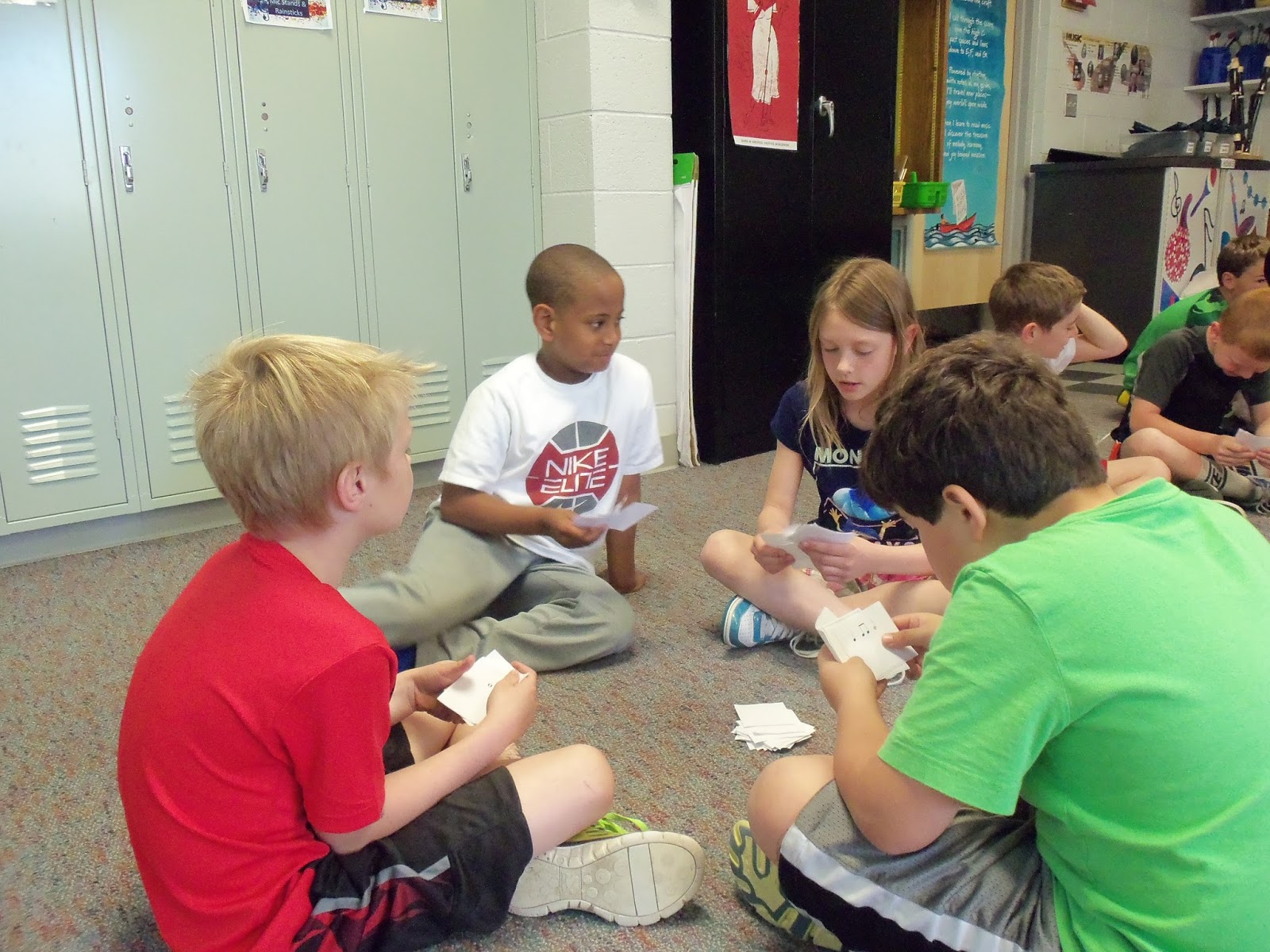 |
| One more group playing Rhythm Go Fish. |
 |
| These ladies are learning about the clarinet on Instruments 360. |
 |
| These young men are learning about folk instruments on the app Instruments 360. |
 |
| A very clean and clear listening map for Los Mariachis. |
 |
| This student is hard at work on his listening map! |
 |
| A final copy of a Los Mariachis listening map. Great work, ladies! |
 |
| Another student hard at work on her listening map! |
Subscribe to:
Posts (Atom)